PCA Evidence of Southern Italian Affinity
In my previous analysis, Link
I examined the close genetic links between Ashkenazi Jews, southern Italians, and Italkim Jews.
I used Italkim Jews as a falsification test because they have no central, northern Italian, or Eastern European ancestry, yet they still show high FST and PCA affinity with both southern Italians and Ashkenazi Jews. This demonstrates that the observed overlap is not driven by northern or Eastern European admixture.
Next, we will review a peer-reviewed PCA study confirming this overlap and show how Ashkenazi Jews can be accurately modeled using qpAdm, reflecting their strong connection to southern Italy.
Schuenemann 2017 PCA: Ashkenazi Overlap with Southern Italians, Sicilians, and Maltese
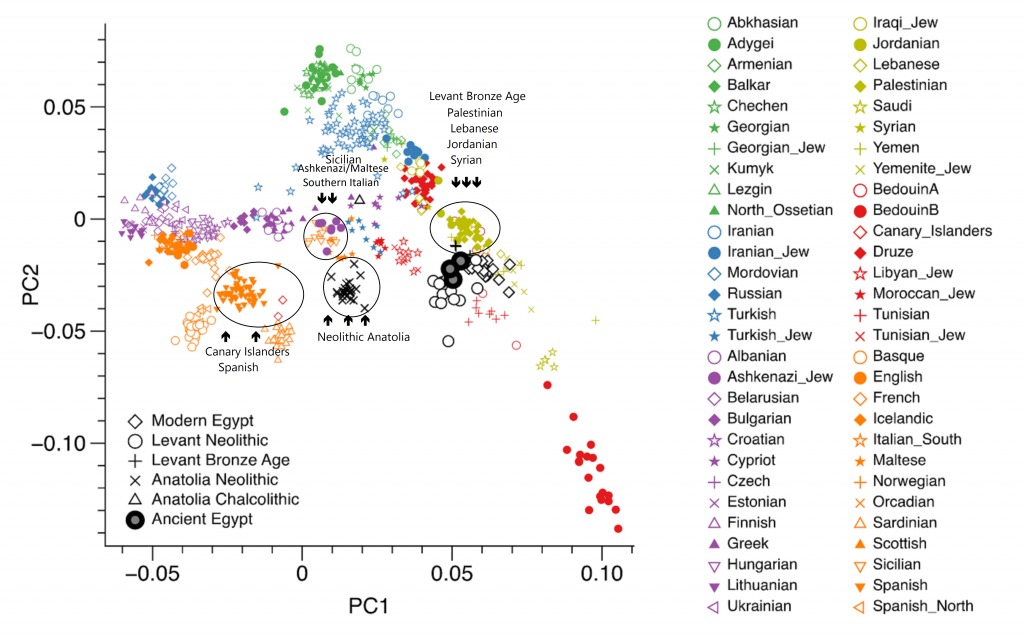
The Schuenemann 2017 PCA shows Ashkenazi Jews cluster tightly with southern Italians, Sicilians, and Maltese near Neolithic/Chalcolithic Anatolians, while Bronze Age Levantine populations form a separate cluster.
Canary Islanders are included as a real‑world comparison group. They have an average autosomal composition of roughly 75 % Iberian/Spanish, with substantial North African and a small sub‑Saharan component (study). In PCA, they do not overlap with Spaniards at all; instead, they sit adjacent to them and are partially pulled toward Sardinians. Even with this overwhelmingly Spanish-derived ancestry, they still do not replicate the near-complete overlap seen between Ashkenazi Jews and southern Italians, Sicilians, and Maltese.
This demonstrates that PCA can distinguish populations with overwhelmingly related ancestry, and that the Ashkenazi overlap with southern Italians, Sicilians, and Maltese is exceptional. It cannot be explained by generic Iberian or proportional ancestry alone, confirming a genuine genomic affinity and clear separation from Bronze Age Levantine clusters.
qpAdm Modeling of Ashkenazi Jews
My qpAdm modeling was designed to address a problem I noticed with prior three-way models of Ashkenazi ancestry. For example, Waldman et al. modeled Ashkenazi Jews using southern Italians, Russians, and Lebanese as sources (study), producing roughly:
| Source | Mean Ancestry Proportion |
|---|---|
| South Italian | 65% |
| Middle Eastern (Lebanese-type) | 19% |
| Eastern European (Russians) | 16% |
In Waldman et al.’s 3-way model, both Levantine and Russian ancestry proportions are artificially elevated. The generic southern Italian source failed to capture regional variation, so some variation that truly belongs to southern Italians was misattributed to Lebanese and Russian proxies, producing misleading ancestry estimates.
Replacing the generic southern Italian source with Sicilians and using precise Levantine proxies such as Syrians, Jordanians, or Palestinians corrects this. Corrected qpAdm runs show Ashkenazi ancestry is 85–87 percent Sicilian-centered, around 8 percent Levantine with a standard error of ±3.50 percent, and 4–6 percent Eastern European. These results align much more closely with PCA and FST clustering.
This also fits historical evidence. The Italkim communities, the overwhelmingly direct progenitors of later Ashkenazi Jews, were located in southern Italy, and PCA and FST geometry confirm that Ashkenazi genomes anchor over southern Italy only with overwhelmingly admixed ancestry from that region. The Canary Islander comparison further demonstrates the precision of PCA, as even 75 percent Iberian or Spanish ancestry does not replicate the close overlap seen between Ashkenazi Jews and southern Italians, Sicilians, and Maltese.
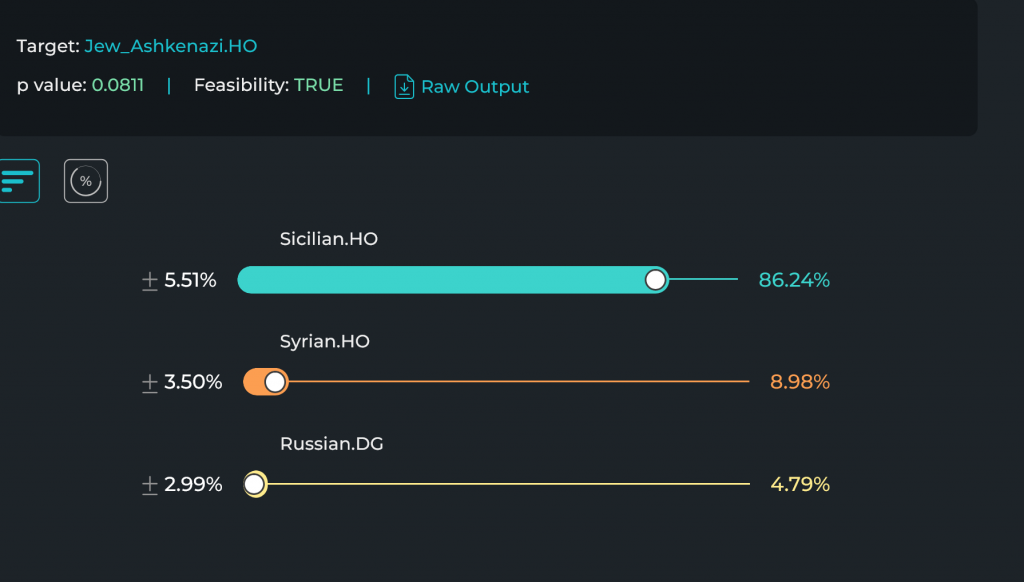
| Source | Proportion | Standard Error |
|---|---|---|
| Sicilian.HO | 86.24% | 5.51% |
| Syrian.HO | 8.98% | 3.50% |
| Russian.DG | 4.79% | 2.99% |
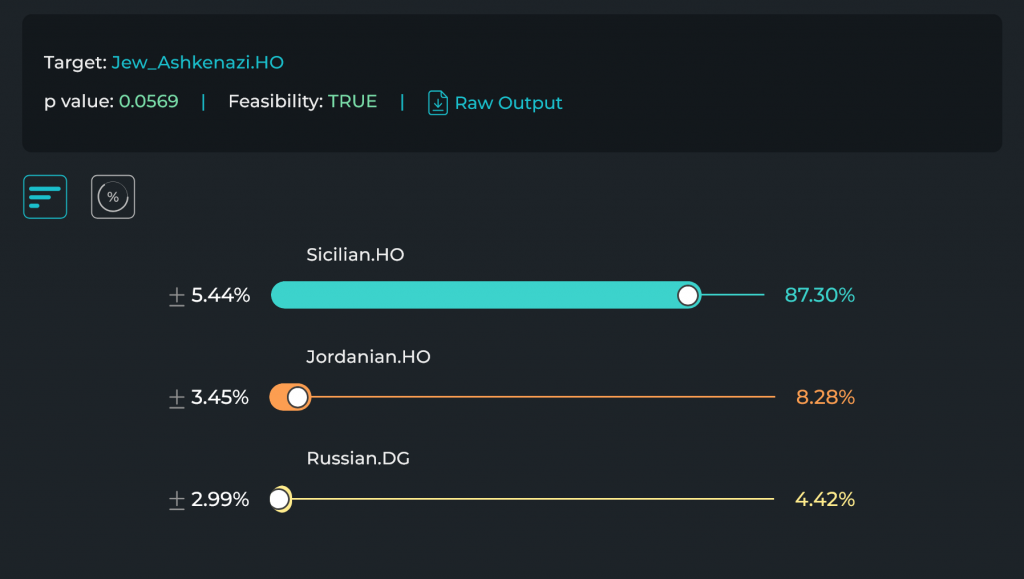
| Source | Proportion | Standard Error |
|---|---|---|
| Sicilian.HO | 87.30% | 5.44% |
| Jordanian.HO | 8.28% | 3.45% |
| Russian.DG | 4.42% | 2.99% |
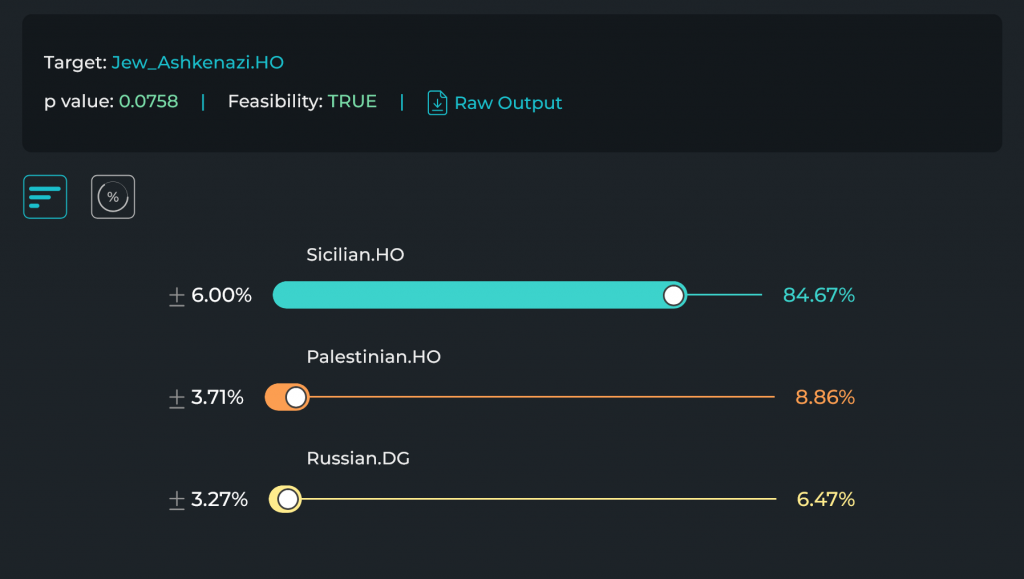
| Source | Proportion | Standard Error |
|---|---|---|
| Sicilian.HO | 84.67% | 6.00% |
| Palestinian.HO | 8.86% | 3.71% |
| Russian.DG | 6.47% | 3.27% |
Using Lebanese as a Levantine proxy in prior models inflates Levantine ancestry in Ashkenazi Jews because the Lebanese source absorbs variation that truly belongs to southern Italians. This competition effect also indirectly inflates the Russian/Eastern European proportion, producing unrealistic estimates (~19% Levantine and ~16% Russian) while failing to match PCA and FST clustering.
By replacing generic southern Italians with Sicilians and using precise Levantine proxies like Syrians, Jordanians, or Palestinians, the qpAdm results produce ~85–87% Sicilian-centered ancestry, ~8% Levantine (±3.50%), and ~4–6% Russian/Eastern European.
These corrected proportions align closely with PCA and FST, reflecting the true autosomal position of Ashkenazi Jews over southern Italy. They also correspond with historical evidence, as the Italkim communities in southern Italy were the overwhelmingly direct progenitors of later Ashkenazi populations.
Conclusion
The Schuenemann 2017 PCA makes the core point visually: Ashkenazi Jews overlap tightly with southern Italians, Sicilians, and Maltese, while remaining clearly separate from Bronze Age Levantine populations. This is not a vague Mediterranean similarity. The Ashkenazi cluster sits with the southern Italian and central Mediterranean group near Neolithic and Chalcolithic Anatolians, not with the Levantine Bronze Age cluster.
The Canary Islander comparison shows why this matters. Canary Islanders have roughly 75 percent Iberian/Spanish ancestry, yet they still do not overlap with Spaniards in PCA. They sit adjacent to Spaniards and are pulled toward Sardinians. That demonstrates that PCA does not casually collapse populations into a source group just because they have a large ancestry fraction from it. If anything, it shows how precise the PCA signal is.
That makes the Ashkenazi overlap with southern Italians, Sicilians, and Maltese much harder to dismiss. You do not get that level of PCA and FST alignment over southern Italy from only a partial or generic southern Italian component while adding inflated Levantine and Slavic ancestry. A model with 65 percent southern Italian, 19 percent Lebanese-type Levantine, and 16 percent Russian does not fit the observed geometry. The Russian component would pull the population away from southern Italy toward Eastern Europe, not magically anchor it over southern Italy.
The corrected qpAdm runs solve that contradiction. Using Sicilians as the southern Italian source and more precise Levantine proxies such as Syrians, Jordanians, and Palestinians produces consistent results: roughly 85–87 percent Sicilian-centered ancestry, around 8 percent Levantine ancestry, and 4–6 percent Russian/Eastern European ancestry. These results fit the PCA, FST, and the historical geography far better than the older Lebanese-based model.
Taken together, the evidence points in the same direction. Ashkenazi Jews are not best explained as a mostly Levantine population shifted by European admixture, nor as a generic Levantine-European intermediate. Their autosomal position is overwhelmingly anchored in southern Italy, with much smaller Levantine and Eastern European contributions. That is exactly what the PCA, FST, qpAdm results, and the historical role of southern Italian Jewish communities predict.