Wikipedia’s Y-DNA Section: Gatekeeping, Ideology, and Recycling Slop
Wikipedia’s 2026 Ashkenazi Y-DNA section on Ashkenazi Jews begins with a 26-year-old study, Hammer et al. 2000, which states that Diaspora Jews from Europe, Northwest Africa, and the Near East resemble each other more closely than they resemble their non-Jewish neighbors. This framing is misleading because it ignores that Ashkenazi paternal substructure was largely established in Southern Italy and among Italkim ancestors before any migration into the Rhineland.
Small studies such as Shen 2004 (n=20), Nebel 2001 (n=79), Semino 2004 (~77), and Behar 2004 (~442, coarse resolution, without Southern European reference) are treated as authoritative despite being insufficient. Hammer 2009 is cited later, but it pools Ashkenazi and non-Ashkenazi Jews without subgroup frequencies, giving no resolution for Ashkenazi-specific paternal lineages and inflating the illusion of a homogeneous Levantine cluster.
Northern and Central Europeans are treated as the default European reference. Southern Italians, Sicilians, Maltese, Aegean Greeks, are not included in the comparisons, creating reference bias and contributing to misinterpretations of Ashkenazi intermediacy. Small samples, low-resolution haplogroups, and missing comparators are presented as certainty, while proper Mediterranean references are ignored.
When proper comparators are included, Southern Italian and Aegean populations show that Ashkenazi J2 and E-M123 frequencies fall within Southern Italian ranges, while Levantine populations are J1-dominant. Moderate J1 in Ashkenazi Jews reflects founder effects and drift rather than a Levantine majority.
Wikipedia presents its haplogroup table as if it were definitive, recycling decades-old, comparator-poor studies. The section enforces an inherited narrative in which missing Southern European and Aegean populations are treated as absence, and Northern and Central Europeans are the default reference. The result is curated slop that misrepresents Ashkenazi Y-DNA.
The section perpetuates the illusion of Levantine predominance and ignores the central Mediterranean and Southern Italian foundations of Ashkenazi paternal lineages. It fails to account for methodological flaws such as small sample sizes, low-resolution haplogroups, and biased reference populations. By treating these limited datasets as authoritative, Wikipedia misleads readers and continues decades of structural slop in Y-DNA interpretations.
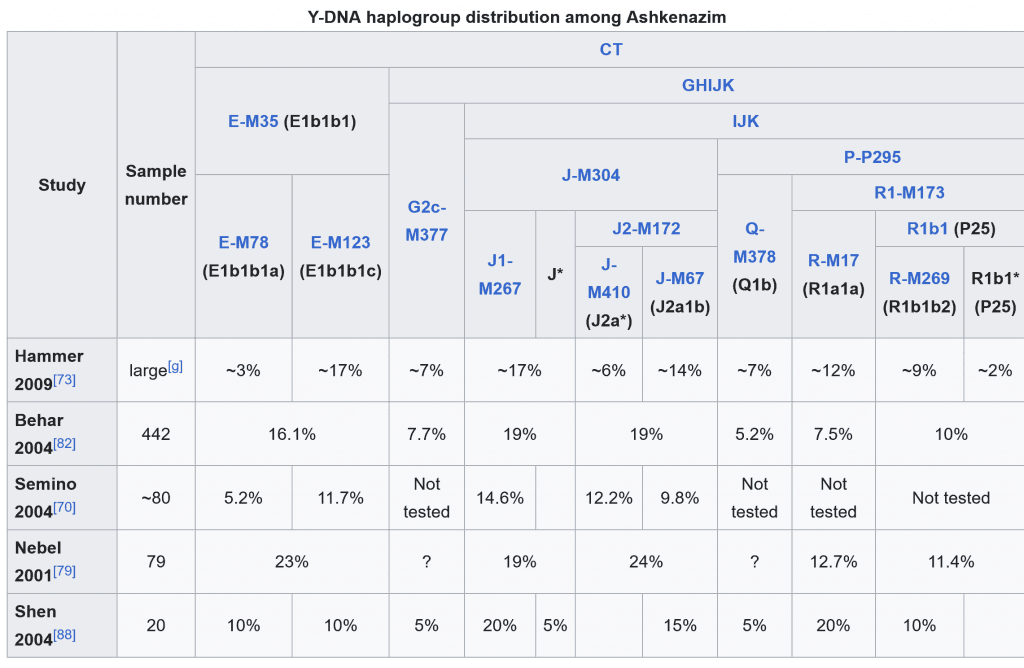
Screenshot of Wikipedia’s 2026 Ashkenazi Y-DNA section. Most cited studies are extremely small (Shen 2004 n=20, Nebel 2001 n=79, Semino 2004 n≈77), and Behar 2004 analyzed ~442 Ashkenazi Jews but reported haplogroups at coarse resolution and lacked Southern European comparators. Only Hammer 2009 is large (n=1,575) but pools Ashkenazi and non-Ashkenazi Jews without reporting subgroup frequencies. Only Semino 2004 includes Southern Italian comparators. Other studies omit Southern European or Aegean reference populations. The table presents coarse haplogroup bins (J, E) as if they are uniquely Levantine, recycling decades of low-resolution, comparator-poor data as authoritative.
Autosomal Synthesis and the 2013 NJ Tree: Recycling Slop Across Studies
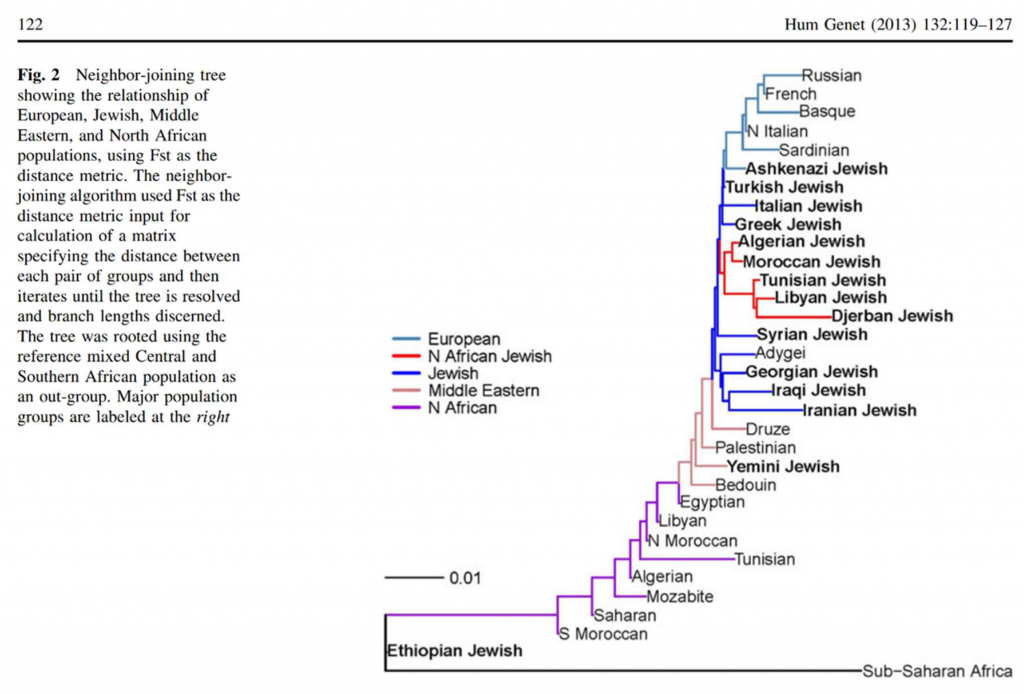
The problems identified in Wikipedia’s Y-DNA section are not isolated. Ostrer and Skorecki’s 2013 synthesis of autosomal studies extends the same structural slop into genome-wide analyses. Their synthesis draws on multiple studies, including Atzmon 2010, Behar 2010, Kopelman 2009, Bray 2010, Listman 2010, and Campbell 2012. Despite differences in sample composition, size, and populations analyzed, the convergence of these studies is treated as evidence of shared ancestry among major Jewish groups.
The structural flaw mirrors the Y-DNA problem. Southern Italians, Sicilians, Maltese, Aegean Greeks, the populations most relevant to Ashkenazi genetic ancestry, are absent from most studies.
When Italian populations are included, they are often misrepresented using Northern Italian, Tuscan, or Sardinian proxies. This misrepresentation distorts the Italian contribution to Ashkenazi ancestry.
Northern and Central Europeans are treated as the default European comparator. Anything outside that baseline is automatically labeled Levantine.
This combination creates the illusion of a Europe-Levant intermediate position. It inflates Levantine assignments while obscuring the central Mediterranean affinities that actually characterize Ashkenazi ancestry.
The neighbor-joining tree from Ostrer and Skorecki 2013 visually reinforces this artifact. Ashkenazi Jews appear intermediate between Northern Europeans and Levantine populations, but this placement is an artifact of missing southern Mediterranean comparators. When those populations are included, Ashkenazi Jews resolve firmly within a central Mediterranean cluster, confirming the same patterns your preprint identifies across both autosomal and Y-DNA analyses.
For a historically grounded test, see the previous article A Falsification Test of Ashkenazi Ancestry Using Italkim Jews, which demonstrates how Italkim Jews reproduce the southern Italian, Sicilian, Maltese, and Aegean clustering observed in Ashkenazi populations. This confirms that the patterns visible in NJ trees and autosomal syntheses are not statistical artifacts or the result of later European admixture but reflect real population-historical structure rooted in southern Italy.
In conclusion, both the Y-DNA analyses and the neighbor-joining tree syntheses reveal the same structural problem in Ashkenazi genetic studies: key Mediterranean reference populations are missing or misrepresented. Southern Italians, Sicilians, Maltese, Aegean Greeks, are largely absent or replaced with inappropriate proxies, inflating Levantine assignments and creating the false impression of intermediacy.
When these relevant populations are properly included, Ashkenazi Jews consistently cluster with the central Mediterranean, particularly Southern Italy, demonstrating that their paternal and autosomal ancestry is rooted in this region rather than being predominantly Levantine.
The patterns visible in both Y-DNA and genome-wide NJ analyses are not statistical artifacts or products of later European admixture. They reflect real historical and population-genetic structure formed before Ashkenazi migration into Northern Europe. Studies that ignore Southern European comparators or rely on pooled, low-resolution datasets continue to mislead readers and perpetuate decades of structural slop.
Correctly accounting for Mediterranean populations clarifies Ashkenazi origins and emphasizes the central role of Southern Italy and the Aegean in the formation of Ashkenazi genetic structure. Any narrative that omits these populations is incomplete and methodologically flawed.